
Adapting Shakespeare is hard enough. Orbiting Shakespeare — building an original story that draws on his plays, his life, or his sources — is different and potentially harder.
After all, Shakespeare was a man and his work is history, literature, a pillar of Western Civilization, as sacred as scripture and depending on its translation, just as difficult to understand.
But it doesn’t have to be. There are rules, most of them unwritten, and God help you if you violate any one of them. Nevertheless, few will ready for the challenge, hoping to draw all cultural, educational, and entertainment enthusiasts to a new tale.
That’s the premise of our Shakespeare Divergent series: films based on Shakespeare that diverge into a fresh story.
Hamnet (2025)
Chloé Zhao’s adaptation of Maggie O’Farrell’s novel imagines the emotional backstory behind Shakespeare’s Hamlet. It begins by clarifying that Hamnet and Hamlet are linguistic equals, blurring the lines between her telling and his prevaricating prince.
After the death of their son Hamnet to plague, Agnes and William Shakespeare are left to process a grief that will eventually reshape into art. Rather than dramatizing Shakespeare as a literary icon, the film centers Agnes and speculates on the personal devastation that may have inspired Hamlet itself.
It’s unfortunate for Chloé to forget the play is based on a Norse tale that Robert Eggers retells (below), not on Hamnet, but she makes some clever connections on the stage.
The real challenge with his work, as I complain repeatedly, is that there is so little conflict in the story. Each story event isn’t debated but experienced without much reflection, except for Hamnet’s death. This slice of life — mostly depressing — tale needs sharpening. If the family is going to struggle with William disappearing to London for months at a time, have that struggle! Use words!
Agnes’ abandonment issues come from her mother, not from William, so blaming him for not being there to say goodbye to Hamnet sounds absurd and petty.
As I said, this “fairytale” is really about Agnes overcoming her “forest witch” identity by abandoning the belief she can dream up her future by pinching anybody’s thumb.
Rosencrantz & Guildenstern Are Dead (1990)
Tom Stoppard’s adaptation of his own play tells the Hamlet play from its margins. Rosencrantz and Guildenstern — two minor, largely interchangeable courtiers in Shakespeare’s original — become the protagonists here, wandering through the events of the play with almost no understanding of the plot they’re trapped inside. Scenes from the source play occasionally intrude on their world, glimpsed from odd angles, while a fixed and tragic ending bears down on two characters who can’t see it coming and couldn’t stop it if they could.
It’s hilarious at times. It’s theatre-geek Monte Python in others. R&G are clueless and unbothered throughout, which does limit the audience appeal. It’s very well acted, though I thought Iain Glen’s performance as Hamlet was flat.
The Northman (2022)
Robert Eggers’ brutal Viking epic flips the direction of the series: instead of a film built around Shakespeare, this is a return to the Scandinavian legend of Amleth — the same source material Shakespeare drew on for Hamlet — filtered through Eggers’ unrelenting, myth-drenched vision, with clear echoes of Macbeth as well. Where Shakespeare civilized this myth into a high-class psychological study of procrastination and indecision leading to tragedy, Eggers strips it down to prophecy, blood rituals, and a hero consumed by vengeance.
This is perhaps the most daring divergence on the list. It not only merges the darkest aspects of Macbeth to the Amleth story, it also flips the script, making Amleth the wrecker of a happy home! There’s no castle or kingdom to save, and his dear mother was behind the original killing! She’s the villain, while Shakespeare envisioned a lost soul.
That shocking revelation makes The Northman one for the ages.
Shakespeare in Love (1998)
A young, struggling William Shakespeare has writer’s block and a play with no ending — until he falls for Viola de Lesseps, a nobleman’s daughter disguised as a man to act in his company. Their doomed romance bleeds directly into the play he’s writing, transforming a working title into Romeo and Juliet. It’s the lightest entry in the series: a fictional, comedic “what if” about where Shakespeare’s greatest love story actually came from.
This is a funny take on the bard’s backstory while developing Romeo and Juliet with a dose of Twelfth Night. An absolute masterpiece, a “triple lindy” — making something that is romantic, funny, educational, charming, etc. It’s crazy good, and if it wasn’t for the nudity, it would be enrichment for any school in the world!
Perhaps my edit could be used, eh?
Developing Shakespeare Divergent Stories
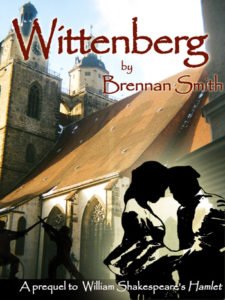
As you may know, I wrote [a / the] prequel to Shakespeare’s Hamlet back in the 1990s after someone struggling with Hamlet asked me why the Prince of Denmark was in Germany anyway. My answer: to listen to Martin Luther preach!
Thus began the creative journey that became Wittenberg, a full play in iambic pentameter. I don’t recommend going the “full Monty” as I did since the modern movie-going audience isn’t willing to put up with new verse they didn’t study in school.
That said, I recommend a things to people daring to do likewise:
- Know your source material and the questions that surround it. Why was Hamlet in Wittenberg, Germany, and why would the heir to Denmark’s throne bother desiring to go back if he’s in love with Ophelia?
- Research the World of the Story from a variety of levels so you understand the arena wherein your characters will do battle. Wittenberg rests on 3-legged stool: the political conflict between Sweden and Denmark, Martin Luther’s first attack on the indulgence trade during Lent, 1516, and Shakespeare’s prince.
- Determine which elements have to change for you to tell your story. And can you live with them? I realized that for my prequel, my Hamlet needed a character arc prior to his father’s death so that he would be ready for Shakespeare’s telling. Then, along the way, I realized that to tell MY story as it should be told, my Hamlet was NOT the protagonist. I centered my story on a Swedish soldier who conspires to kidnap Hamlet in order to win the love of Princess Margaret.
- Reconsider orbiting Shakespeare. Seriously. It’s a daunting task. People will contrast your work unfairly. Steal as much as you can and claim you were “inspired” but not trying to shoehorn your project into the bard’s canon. Friends said Wittenberg was an “homage” (ō-ˈmäzh). I just cup my hands like a supplicant and give a half bow. But if you’re going to venture forth, do it boldly, change up the character motivations, throw in surprises, and swing for the fences!
- Strike that balance between “doing right by Billy Shakespeare” and entertaining your audience with extravagance. You don’t want to be pretentious and too erudite for the masses and then realize you’ve got no audience left. Take your craft seriously, but remember “the play’s the thing!”
I hope you enjoyed this review of divergent Shakespeare stories. They’re not often developed. Mostly we get reimagined tales for teenagers, like The Lion King (Hamlet), O (Othello), 10 Things I Hate About You (Taming of the Shrew), She’s the Man (Twelfth Night), or they’re straight up adaptations of the plays (thanks, Kenneth Branagh!).
If you have questions, let me know, or start a conversation on YouTube or X.